Nasa then waited nervously for a signal, which had been expected at 05:00 GMT on 28 December.
Moving at up to 430,000 mph (692,000 kph), the spacecraft endured temperatures of up to 1,800F (980C), according to the Nasa website.
"This close-up study of the Sun allows Parker Solar Probe to take measurements that help scientists better understand how material in this region gets heated to millions of degrees, trace the origin of the solar wind (a continuous flow of material escaping the Sun), and discover how energetic particles are accelerated to near light speed," the agency said.
Dr Nicola Fox, head of science at Nasa, previously told BBC News: "For centuries, people have studied the Sun, but you don't experience the atmosphere of a place until you actually go [and] visit it.
"And so we can't really experience the atmosphere of our star unless we fly through it."
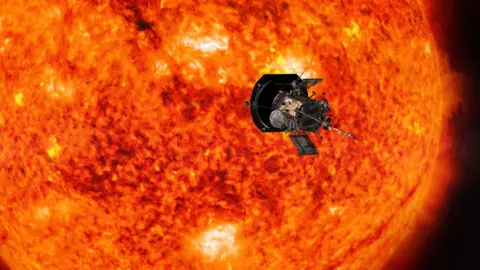
Parker Solar Probe launched in 2018, heading to the centre of our solar system.
It had already swept past the Sun 21 times, getting ever nearer, but the Christmas Eve visit was record-breaking.
At its closest approach, the probe was 3.8 million miles (6.1 million km) from our star's surface.
That might not sound that close, but Dr Fox put it into perspective. "We are 93 million miles away from the Sun, so if I put the Sun and the Earth one metre apart, Parker Solar Probe is 4cm from the Sun - so that's close."
The probe endured temperatures of 1,400C and radiation that could have frazzled the on-board electronics.
It was protected by an 11.5cm (4.5in) thick carbon-composite shield, but the spacecraft's tactic was to get in and out fast.
In fact, it moved faster than any human-made object, hurtling at 430,000mph - the equivalent of flying from London to New York in less than 30 seconds.
Parker's speed came from the immense gravitational pull it felt as it fell towards the Sun.




0 Comments